
































 CONTACT FORM
This article provides a guide on LPG vapor tanks and their domestic use, functioning and safety aspects in recreational vehicles.
The following related tutorials are associated with this article:
LPG installation in a recreational vehicle like a RV Camper, Caravan or Food Truck
Installation instructions for LPG cylinder tanks (vapor tanks) in (recreational) vehicles
How does a tank level gauge work on a LPG tank?
What is an LPG Gas Bottle and what different types are there?
Pressure Regulators for Gas Bottles and Vapor Tanks
The EN 1949 Standard: The European Standard for Safe LPG Systems in RVs and Caravans
Introduction
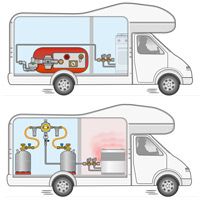
An LPG vapor tank makes it possible to use LPG gas in your RV camper (also called Motorhome), caravan, or foodtruck, for example for cooking, heating, or other purposes. There are many different LPG tanks with different dimensions. This is not without reason, as there is an even greater variety of vehicles with different shapes and sizes. Therefore, it is important that the LPG tank and the vehicle are a match and that the LPG tank has the correct dimensions to be installed properly in or under the vehicle. Given this great variation on the one hand of LPG tanks and on the other hand of vehicles, it is impossible to give specific instructions for each combined variant. (As an alternative, you may consider using refillable LPG gas bottles.)
Important choice: The specific choice of product type and size is the responsibility of the customer/installer, as they are best able to determine what fits best in the vehicle (knowing the vehicle and layout) and what does or does not meet the specific wishes and user goals (heating, cooking, BBQ, etc.). We advise creating an overall plan tailored to the end user's needs, applicable safety requirements, and technical possibilities. For this, we recommend also reading the following article carefully: LPG installation in a recreational vehicle like a RV Camper, Caravan or Food Truck
LPG Vapor Tank
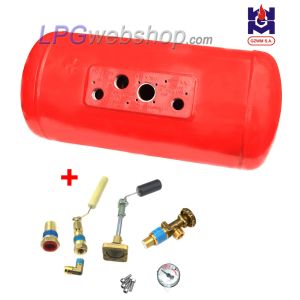
This important component is responsible for storing the liquid LPG and also vaporizing it, so that the gas leaves the LPG tank in gaseous form. LPG vapor tanks come in various shapes, sizes, and variants. For example, LPG vapor tanks exist in cylindrical form or in the shape of a ring or wheel (toroidal). Both types are placed horizontally in or under the vehicle. Most LPG vapor tanks are so-called red 4-hole gas tanks, meaning they are equipped with 4 holes/valves each with its own function such as filling with an 80% fill valve with non-return valve, an overpressure valve, a content gauge (float), and an extraction valve with flow limiter that can be opened and closed (manually/electrically). The red color distinguishes them from LPG tanks intended for powering a vehicle on LPG, which are black and deliver LPG in liquid form to the LPG system.
LPG vapor tanks must have UNECE 67R approval, which makes it possible to use them in a recreational vehicle and to refuel. This is a strict and very safe ECE directive for LPG components for Automotive applications. LPG vapor tanks are always equipped with a separate inlet and outlet.
What is the difference between a black LPG tank and a red LPG vapor tank?
This is a question we often see being asked. Many people assume that the LPG tanks are essentially identical, but that is a mistaken assumption. The manufacturer does not give the tanks a clearly different color for no reason.
A black LPG tank is intended for vehicles that run on LPG and for this reason delivers the LPG in liquid form to the LPG system, which is then vaporized using a vaporizer (and the engine's hot water). The outlet of a black LPG tank is internally connected to the bottom of the tank, so that liquid LPG is extracted. And in a black cylindrical LPG tank, the tank valves are at a 52° angle, while in a red cylindrical LPG vapor tank these are turned more downwards at a 105° angle. Internally, a red LPG vapor tank is different, because here the outlet is connected to the highest internal point of the tank where the LPG is present as a gas. This causes the gas to leave the vapor tank in gaseous form (instead of liquid form). And because of this, a vaporizer (supplied with hot water) is no longer needed to vaporize the LPG. Instead, a pressure regulator is needed to reduce the pressure to a low, safe working pressure for the rest of the system.
But then can't I put a black LPG tank in a different position, so that vapor gas (gaseous form) comes out of the tank? Unfortunately, that will not work, because then the 80% fill valve will be at the wrong angle, causing it to shut off quickly and the LPG tank cannot be filled properly. Furthermore, the LPG system then becomes very unsafe, because the overpressure valve is also in the wrong position, causing it to release liquid LPG instead of vapor gas. And the chance that partly liquid LPG comes out of the tank while driving or when parked on a slope is high. This can lead to large flash fires at the gas appliances. This can therefore create very dangerous situations! In case of accidents, insurance will not pay out in such a case and the damage costs will be at your own expense.
Conclusion: A black LPG tank cannot be used as an LPG vapor tank in an RV camper or caravan, just as the reverse is also not possible!
LPG Gas Storage in an LPG Gas Bottle or LPG Tank. How does that work?
The most important part of the vapor gas system is the LPG tank or LPG gas bottle (or multiple) for storing the LPG. The choice between an LPG gas bottle or LPG tank depends on the required storage capacity and the available space in or under the RV camper (also called Motorhome), caravan, or foodtruck.
An LPG tank and LPG gas bottle is indeed filled and stored with liquid LPG, but a small amount also evaporates and collects in the upper space of the LPG tank or LPG gas bottle. The gas is extracted from the upper space, causing the gas to leave the LPG tank in gaseous form and the pressure in the LPG tank to drop. Due to the pressure drop, liquid LPG evaporates again, causing the pressure to rise again. The evaporation of LPG requires heat (energy). When LPG evaporates, the gas tank cools down slightly. The more heat available, the easier the LPG evaporates and the pressure increases. With high gas consumption, a lot of LPG will also evaporate, causing the LPG tank to cool down significantly. The evaporation process will therefore become increasingly difficult.
Evaporation Process and Temperature Dependence
The evaporation process requires heat extraction from the environment. Propane evaporates better at low temperatures than butane. As a result:
- The pressure in the tank is highly temperature-dependent
- At high consumption and cold conditions, the pressure can drop
- Consider an additional gas bottle for more evaporation capacity in case of high demand
Tank Valves and Accessories
Our LPG tanks are equipped with 4 tank valves / accessories, namely;
- an 80% fill valve with non-return valve. On the 80% fill valve, there is a knee piece with a 1/2" UNF conical flare connection onto which a fill hose can be connected. The fill hose is connected at the other end to a fill connection on the vehicle.
- an overpressure valve (relief valve). This ensures that the pressure in the tank never exceeds 27 bar.
- an extraction valve (manually or electrically operable) with integrated flow limiter and available with different types of connections:
- 5/16" UNF conical flare connection (on electric extraction valve)
- 8mm compression fitting for copper pipe (on manual tank valve)
- Shell connection type Male G.2/G.4/G.8 (W21.8 x 1/14 left-hand thread) (on manual tank valve)
- a tank float (content gauge) with a tank level display (clock) (standard without wiring) mounted on it. To view the tank content on the dashboard (or elsewhere in the vehicle), an optional LED indicator with tank sensor is available. This tank sensor with wiring replaces the tank level display (clock) on the content gauge (can be replaced without opening the tank) and is electrically connected to the LED indicator to display the content.
An optional aluminum gas-tight housing can be mounted on the LPG tank and encloses these appendages and can capture any relief gases.
Optional Use of a Gas-Tight Housing
A gas-tight housing (tank valve housing) is used to protect the tank valves / accessories and, in case of internal installation, to capture any gases released from the overpressure valve on the LPG tank and then be able to vent them via a vent hose and floor vent (floor pass-through) to the outside. A gas-tight housing is certainly required if the LPG tank is placed inside the interior of a vehicle and must be sealed gas-tight using the supplied rubbers. A gas-tight housing is not strictly necessary if the LPG tank is placed in an external space (e.g., with underfloor mounting) or in a ventilated space (which is sealed off from the rest of the vehicle). It is always necessary to protect the tank valves / accessories from dirt and water.
Placement of Gas Tank in Interior / Exterior Space:
In the case that a gas tank is placed inside the interior of the vehicle (internal installation), it is necessary to equip the gas tank with a gas-tight housing, a vent hose, and a floor vent (floor pass-through) for venting any gases to the outside.
A gas-tight housing in combination with a manual valve is not always possible to seal properly...
When using a Manual valve SHELL connection Male G.5 Kombi (G.2/G.4/G.8) (W21.8x1/14 Left-Hand Thread), it is NOT possible to properly seal the gas-tight housing, meaning this combination is only really suitable for underfloor mounting or, in the case of internal installation (interior), only in a ventilated space that is sealed off from the rest of the vehicle.
When using a manual valve with an 8mm compression connection that is directed straight outwards, the gas-tight housing also CANNOT be properly sealed, because there is not enough space to place a gas-tight plastic sealing boot.
In the case of a manual valve with an 8mm compression connection, the gas-tight housing can be sealed gas-tight if the manual valve is installed with its outlet pointing inwards. (The gas line can then be looped inside the housing or exit the housing on the same side as the fill hose).
Why is a Pressure Regulator Needed?
The pressure in a gas tank varies, depending on temperature, between 1 and 20 bar. This pressure is MUCH too high for the gas appliance(s), such as a cooker or heater in your RV camper. Therefore, it is necessary to reduce the pressure to a constant, safe and low pressure. The prescribed working pressure for gas appliances is 30 mbar (older LPG systems or in other applications such as foodtrucks or static caravans sometimes use a working pressure of 50 mbar and sometimes 39 mbar).
This pressure reduction and regulation is done by a pressure regulator, which you connect to the outlet of the gas tank, directly or via a high-pressure connecting line.
Read more about pressure regulators and pressure reduction in this article: Pressure Regulators for Gas Bottles and Vapor Tanks
Type Approvals and Inspection Requirements
LPG tanks are approved according to UNECE R67, a strict standard for automotive LPG applications. Any re-inspection after 10 years depends on national regulations. (Inform yourself about your national regulations). In many countries, a visual inspection suffices for:
- Corrosion
- Damage
- Deformations
IMPORTANT: Keep the Tank Certificate!
Each new LPG tank is delivered with a unique tank certificate. Keep this document carefully as it may be required for vehicle inspection and is difficult to obtain again.
Mounting of LPG Tanks according to EN 12979 (or RDW LPG Installation Guidelines)
Ensure a proper mounting of the LPG tank.
An LPG tank in a (recreational) vehicle such as an RV Camper and Foodtruck must of course be firmly mounted, so that it cannot come loose and move during driving or in the event of a collision. Therefore, make sure it is attached to the vehicle with a sturdy construction. For LPG tanks, the installation requirements as in EN 12979 (or applicable national guidelines such as the RDW LPG installation guidelines in NL) apply. The precise method of mounting depends on the size of the LPG tank and the positioning (underfloor mounting or internal installation, etc.).
We mention a few basic requirements here:
- Have the installation performed by a certified LPG specialist.
- Maintain a minimum ground clearance of 20 cm for underfloor mounting.
- Maintain a minimum distance of 10 cm from heat sources (such as an exhaust)
- LPG tanks must be firmly fixed in the vehicle so that they remain in their position during driving or in an accident.
- Position an LPG tank in the correct position as indicated by the manufacturer, so that it is only possible to extract LPG in gaseous form. Most LPG tanks have a marking on the tank indicating what the central horizontal plane of the tank is and what the top side is.
- Lines must not be the lowest part of the vehicle
- Have the complete installation inspected by a competent authority
- See further the safety requirements and regulations in EN 12979 (or the applicable national guidelines such as the RDW LPG installation guidelines in NL)
Available Mounting Systems
- Tank Frame with tension Straps - Only suitable for cylinder tanks with a diameter of 27cm to 40cm
- Mounting Rings - For welding to angle iron constructions
- Mounting Brackets - With foot attachment to the vehicle
For mounting LPG tanks, we essentially have 3 mounting systems available in our webshop. 1; using a tank frame and ratchet straps that secure the tank to the frame, 2; using mounting rings that clamp around the tank and can be welded to iron angle iron, to attach the assembly to the vehicle, and 3; using mounting brackets that also clamp around a tank and can be attached to the vehicle via a foot on the bracket. These mounting systems are available in different sizes, so they are available for most tank sizes.
Read more about this in our tutorial Installation instructions for LPG cylinder tanks (vapor tanks) in (recreational) vehicles
Positioning and Orientation
Pay attention to the mark on the tank indicating the horizontal mid-plane and the top. The tank valve / accessories should be slightly pointed downwards.

Refueling LPG. Am I allowed to fill my LPG installation at a regular LPG filling station?
To be allowed to fill an LPG tank with LPG while it is in the recreational vehicle, it and the entire LPG installation must comply with various applicable safety requirements and be equipped with proper approval. In some cases (countries), it is necessary to prove that the entire gas system has been approved. (via G 607 approval stickers or registration on the vehicle registration documents).
In Italy, it is only allowed to refuel with LPG at a regular LPG station if the LPG system is officially approved and registered on the vehicle's registration papers. The ministerial legislation of August 3, 2018 Prot. N. 19042 regulates the use and refueling of LPG tanks in recreational vehicles and its transcription in the vehicle registration certificate, as required by Art. 1 point (a) and (b) in the Official Journal No. 102 of 04.05.2018.
In addition to the safety requirements mentioned earlier, we list some additional safety requirements regarding LPG refueling below:
- The electrically or manually operated extraction valve directly on the outlet of the gas tank / LPG gas bottle must always be closed during LPG refueling. If a manual extraction valve is used, it must be located and operable in the immediate vicinity of the LPG fill connection on the vehicle. Or otherwise, an additional manual valve will be placed upstream of the pressure regulator that is located and operable in the immediate vicinity of the LPG fill connection on the vehicle, or otherwise an additional automatic valve will be placed upstream of the pressure regulator.
- The operation of an electric extraction valve must be directly and easily accessible.
- An LPG tank must be equipped with a number of safety features (tank valves) such as an 80% fill limiter with non-return valve, an overpressure valve, a flow limiter, and a closable extraction valve (Manual or Electric) and a valid approval (UN/ECE Regulation No. 67).
- An LPG tank must be permanently and sufficiently firmly mounted in the vehicle (According to EN 12979 or applicable national guidelines)
- The installation from the fill connection up to and including the gas tank must comply with the safety requirements mentioned in EN 12979 (or the applicable national guidelines such as the RDW LPG installation guidelines in NL).
- The installation from the fill connection to the gas tank and from the gas tank to the pressure regulator must undergo a leak test using a leak detection fluid.
- The entire LPG installation must comply with the safety requirements (EN 1949 / G 607 / EN 12979), be equipped with a valid approval, and in some countries also be registered on the vehicle registration.
Furthermore, additional conditions or prohibitions may apply per country and filling station. For example, it is not permitted in every country to refuel LPG yourself or to fill gas bottles.
ATTENTION! Keep in mind that in some countries (Italy and a number of Eastern European countries) self-service LPG refueling is not allowed. This may only be done by the filling station staff. Inform yourself about the rules of each country where you intend to refuel.
TIP! When filling the LPG tank or LPG gas bottle for the first time
In addition to a mandatory leak test, it is advisable to check the gas tank and connections (such as the valves on the tank, the fill hose, and fill connection) for any leaks before filling the gas tank with LPG. To pressurize the gas tank, you can simply connect the refueling nozzle from the LPG filling station to your fill connection (without activating the pump). This allows a limited amount of LPG to flow from the nozzle and hose into the gas tank, as it is still pressure-free. This limited amount of LPG evaporates in the gas tank and thereby builds up a gas pressure in the tank sufficient to detect any leaks. LPG also has a strong odor, so a leak should also be noticeable because of that. Check thoroughly for leaks with a gas leak detector spray (or alternatively a plant sprayer with soapy water) and spray it on the various couplings and connections. Only when you know everything is leak-free and properly connected is it possible to fill the tank further.
Examples of Associated Products
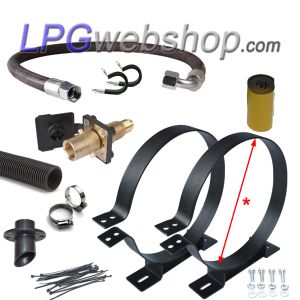




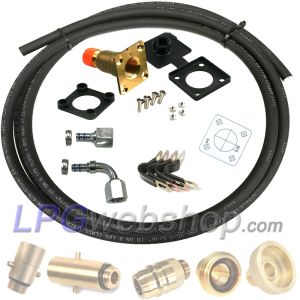
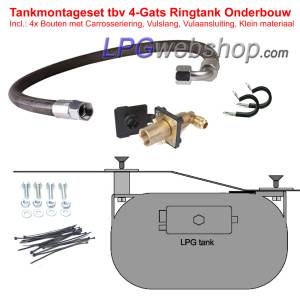
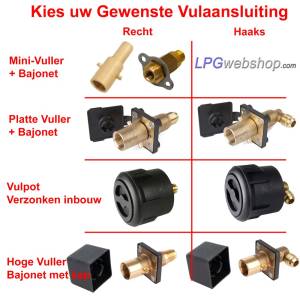
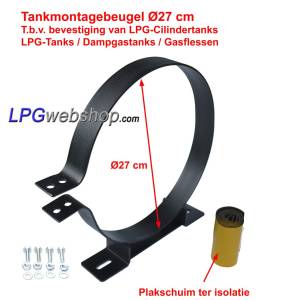
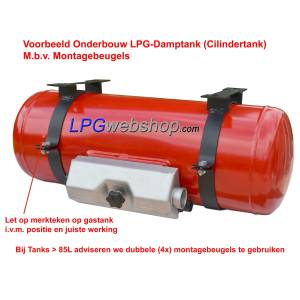


Associated product categorie
Cylindrical Camper LPG Tanks
Toroidal Camper LPG Tanks
Tank Mounting frames & Straps
Cyl. Tank Brackets
Tank Fixation Rings
This article is protected by copyright. (Partial) reproduction of this article is punishable.
Disclaimer
The information in this article is intended solely as an aid and has been compiled to align as well as possible with applicable regulations and guidelines. National regulations may deviate from this or impose additional requirements. Installers and users are themselves responsible for (having) the gas installation checked and complying with applicable local laws and regulations. Always consult a certified professional for this.
Despite the care with which this information has been compiled, there is a possibility of errors and omissions. No rights can be derived from this article. The most recent and local official standards and regulations are always leading.
In addition to this specific disclaimer, our general disclaimer also applies, the link to which can be found in the menu in the footer (page end).
x